Levels give you stat points. Traits give you a different weapon. That is the cleanest way to describe the split XLGAMES built: your character level raises numbers, while the trait tree changes what your skills do, adds new ones, and lets two players with the same weapon fight in completely different ways.
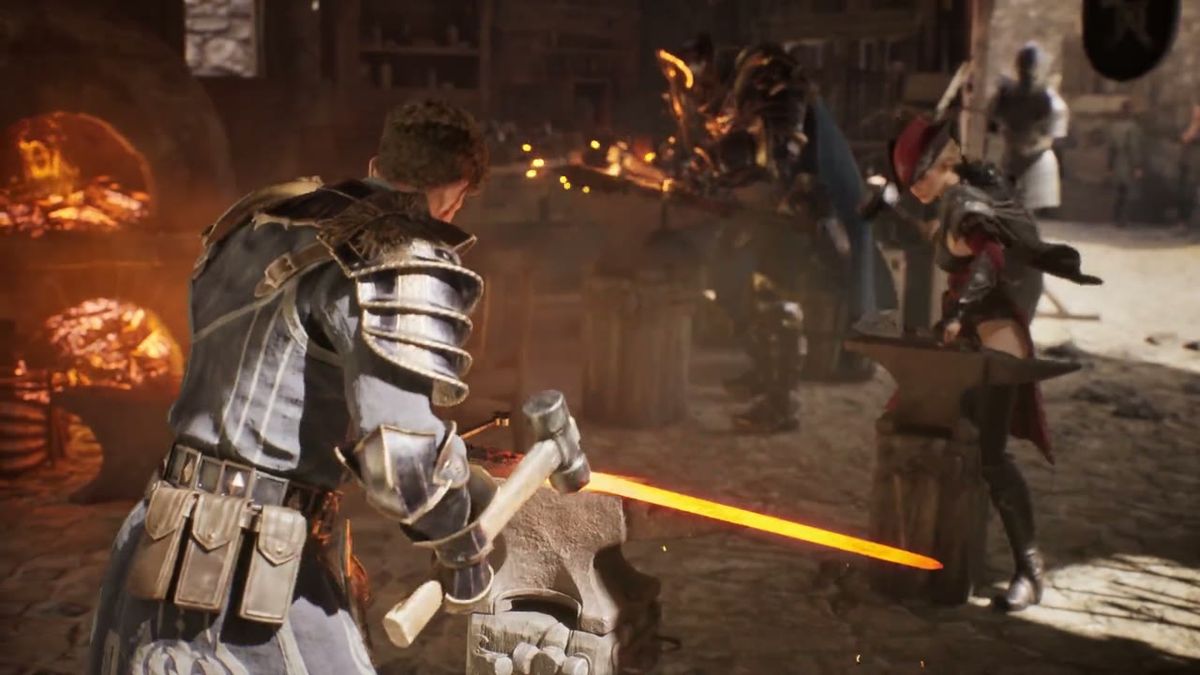
Where trait points come from
Every trait point in the game comes from Raeven's Coilstones. Each Coilstone sits near a powerful boss: some in the open world, some hidden, and some that only appear through specific quests. If you have found a Coilstone, there is a fight between you and it.
The design intent is explicit. XLGAMES wanted exploration to pay off in combat, so the reward for beating a Coilstone boss is a new skill or a new way to play, not a stat bump. That has three practical consequences:
- Trait points are not level-gated. A player who hunts Coilstones early is stronger than a player who grinds monsters.
- The bosses are the gate. If you cannot beat a Coilstone boss, you are not ready for its points, and the game expects you to come back.
- You will be behind if you ignore them. A character with 20 unspent trait points is a character playing with half a kit.
How the tree is shaped
Every weapon type has its own tree, and the tree has three kinds of nodes:
| Node type | What it gives | Why it matters |
|---|---|---|
| Stat nodes | Small boosts that carry you along a path | They make the path worth walking even before the payoff |
| Skill nodes | Brand-new skills for that weapon | The reason to push deep into a branch |
| Modifier nodes | Changes to an existing skill | Turns a familiar kit into a different one |
Because the paths branch, you cannot take everything. The tree is a statement about how you want to fight, not a checklist.
The Greatsword example, in full
The official progression post uses one weapon to explain the whole system, and it is worth walking through.
A Greatsword Warrior who takes the damage branch unlocks Armor Break and changes sunder into Sweeping Slash: two hits instead of one, with a wider cleave arc. Against a pack, that is a huge upgrade. Against a boss with a short punish window, the second hit is exactly the animation you cannot afford.
The same Warrior taking the defensive branch instead picks up Pummel Strike, an attack usable while guarding that also grants a shield to absorb damage. That node does not raise damage at all. It raises the number of mistakes you can survive, which in a game where healing is scarce is a damage increase in disguise.
Two players, same weapon, opposite builds. Both are viable. The tree is doing what it promised.
Respeccing is not a described feature
XLGAMES has talked about how point costs, tree layout and which skills get alternate versions will evolve during Early Access, based on feedback. It has not described a free respec system. Treat your early trait choices as a commitment you will live with for a while, and pick the branch that matches how you already fight.
How to plan your first tree
Take the first skill node before the stat nodes. A new skill changes your options; a 3% stat bump does not. The early stat nodes are there to make the path affordable, not to be the goal.
Decide whether you are building for packs or for single targets. Sweeping Slash-style modifiers are pack tools; shield-granting and guard-attacks are boss tools. The game has both, and the tree usually asks you to pick.
Match the tree to your stats. A defensive tree with an all-Strength stat spread is a character with a shield and no health to use it. The two systems are meant to be planned together.
Do not split weapons. Traits are per weapon. Two half-built weapons are worse than one finished one, and the second weapon can wait until you have trait points to spare.
Where the Coilstone hunt fits your week
A workable loop for a fresh character:
- Push the region questline until it hands you a boss.
- Clear the Coilstone nearest that boss and spend the points immediately.
- Use the new skill on the next quest boss, so you learn what it actually does.
- Dive one dungeon once the tree has two skills in it.
- Repeat in the next region.
The loop matters because the game's difficulty is tuned around the assumption that you are spending trait points. A player who skips step two will find the second region noticeably harder than the first, and will blame gear.
Traits and the rest of progression
Traits sit between stats and gear in the power curve. Stats decide your baseline numbers, traits decide your options, and gear from field bosses and chests fills the gaps. Progression sources maps all three onto a single page if you want the overview before you commit to a route.